
I visited the International African American Museum located on Gadsden’s Wharf in Charleston, South Carolina. Gadsden’s Wharf was the first destination for an estimated 100,000 enslaved Africans during the peak of the international slave trade. Some researchers estimate that 40% of the enslaved Africans in the United States landed at Gadsden’s Wharf.

The museum covers the history of Africans in America starting with the Black Conquistadors that arrived with the Spanish in the 1400s and 1500s then the enslaved Africans in the Spanish territories long before slavery was introduced in Jamestown in 1619. The museum was careful not to leave out the enslaved Native Americans in those same territories.
While the museum speaks about the slave trade in other states and other parts of the world, the focus is mainly on South Carolina, the crops that were grown there, the people who grew them and the conditions for growing them.

The museum isn’t just about struggle. The museum highlights the Gullah Geechee culture that is local to specific to the sea islands from North Carolina, South Carolina, Georgia and northern Florida. Their culture has kept its closeness to African cultures because it has not had outside interference.

On the grounds of the International African American Museums is this shallow reflecting pool with engraved bodies along the bottom, each representing a man, woman or child who was packed into the hull of a slave ship, unable to move for weeks or months.
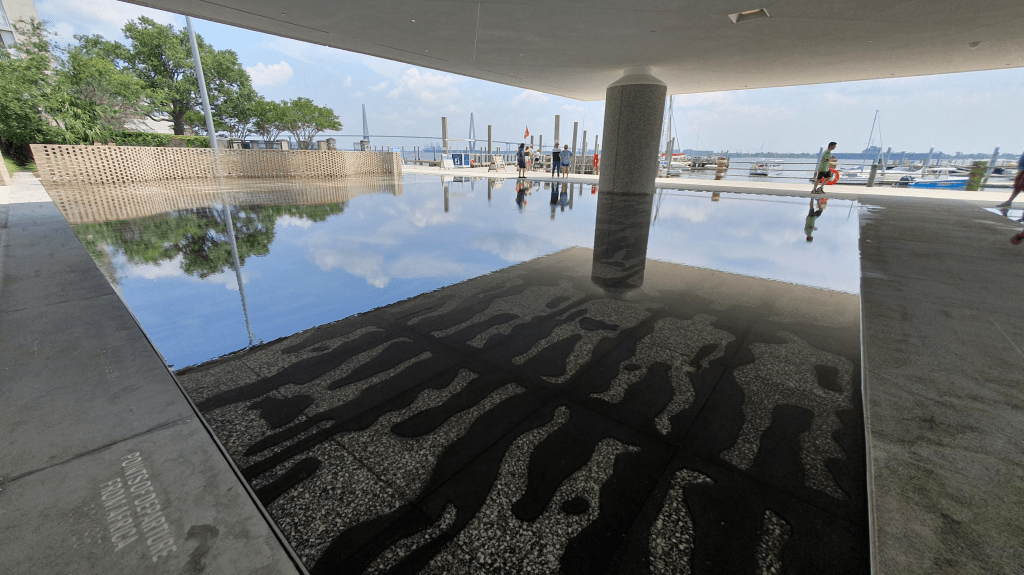
For me, the water appears to seamlessly blend into the Cooper River in the distance. The bodies allude to the Africans that never made it to shore.
From this visit, I have so many things to investigate further. One thing, in particular, is that SlaveVoyages.org has the names of Africans when they left Africa and the new names given to them when they arrived in the Americas. If we can trace our Ancestors back to arrival in the Americas, we may actually be able to determine where our individual ancestors came from.
 genealo.ME