The Bureau of Refugees, Freedmen, and Abandoned Lands, also known as the Freedmen’s Bureau, was established in the War Department by an act of Congress on March 3, 1865. The Bureau was responsible for the supervision and management of all matters relating to the refugees and freedmen and lands abandoned or seized during the Civil War, duties previously shared by military commanders and US Treasury Department officials. Although the Bureau was not abolished until 1872, the bulk of its work was conducted from June 1865 to December 1868.
While a major part of the Bureau’s early activities included the supervision of abandoned and confiscated property, its mission was to provide relief and help formerly enslaved people become self-sufficient. Bureau functions included issuing rations and clothing, operating hospitals and refugee camps, and supervising labor contracts between planters and freedpeople. The Bureau also managed apprenticeship disputes and complaints, assisted benevolent societies in the establishment of schools, helped in legalizing marriages entered into during slavery, and provided transportation to refugees and freedpeople who were attempting to reunite with their family or relocate to other parts of the country. As Congress extended the life of the Bureau, it added other duties, such as assisting Black soldiers and sailors in obtaining back pay, bounty payments, and pensions.
The Freedmen’s Bureau’s Fort Monroe office played a central administrative role in stabilizing freed families in southern states after the Civil War. Their assistance primarily focused on preventing destitution through government-sponsored relocation and facilitating the recovery of wages to support these households.
Coordinating Legal and Financial Redress
The Fort Monroe office also acted as an intake center for legal claims that would financially support these families. When local resolution was not possible, officers at Fort Monroe forwarded cases to the appropriate jurisdictions.
- Wage Recovery: In the case of Isaac Hollowman, Captain C.B. Wilder at Fort Monroe received the claim for unpaid wages against a debtor in Southampton County. Recognizing the debtor lived outside his immediate jurisdiction, Wilder referred the case to Captain A.S. Flagg in District No. 1, urging him to “aid this man to recover the money justly due him”. It seems that his request got caught up in a bit of bureaucracy, though.
- Inter-District Communication: This referral system ensured that freedpeople at Fort Monroe could pursue claims in other counties without having to travel there immediately themselves. The Fort Monroe officers acted as the initial advocates, pushing other districts to “attend to the collection of the money immediately”.
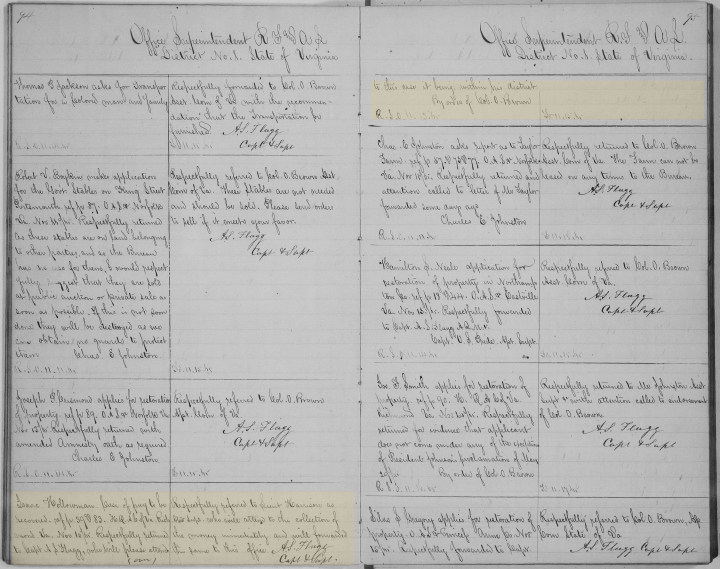
On this page from a Freedmen’s Bureau endorsement book, an entry dated October 3, 1865, by Lt. Stuart Barnes requests that “Isaac Hollowman be aided in collecting pay due him by Widow Benford living in Southampton Co. for services of his son.” The request was first sent to Surry County.
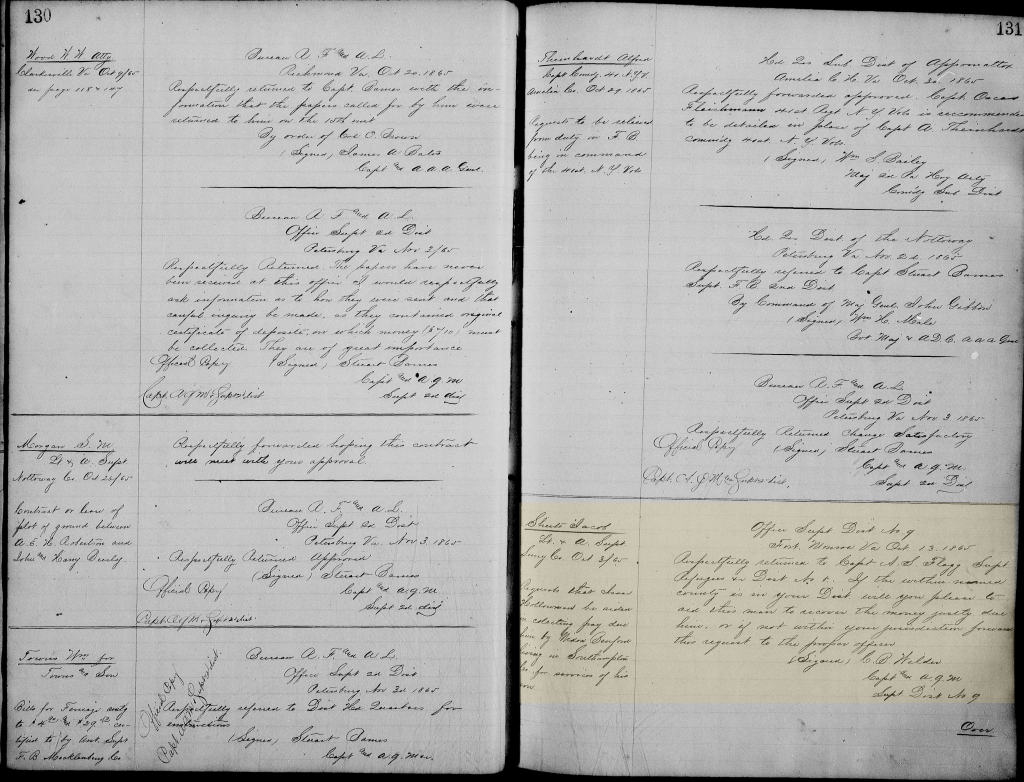
This page tracks the movement of Hollowman’s wage claim. On October 13, 1865, Capt. C.B. Wilder at Fort Monroe forwarded the communication regarding money due to “Isaac Hollowman” to Capt. A.S. Flagg. On October 16, Capt. Flagg then referred the matter to Capt. Stuart Barnes in Petersburg for adjudication.
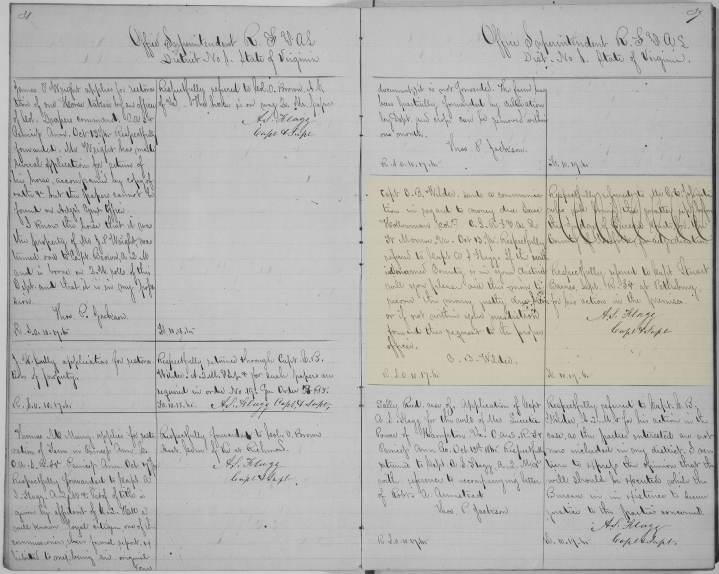
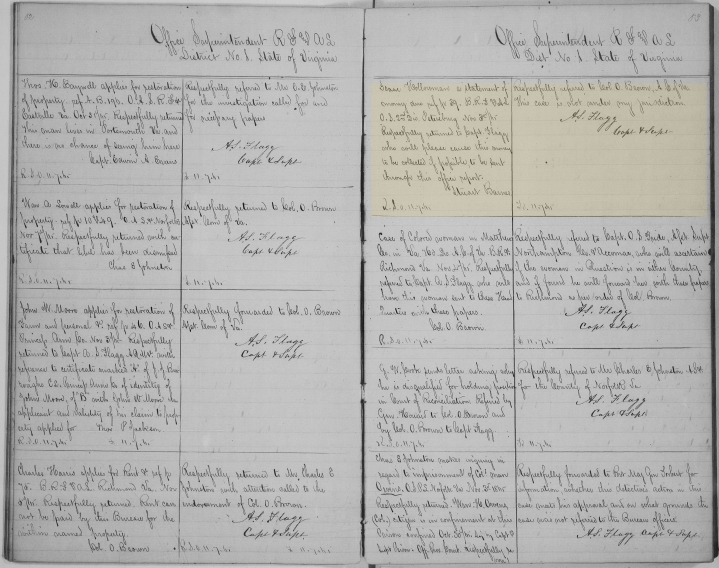
This page records the later stages of the wage claim. An entry dated November 10, 1865, from Richmond refers the “case of pay to be recovered” back to Capt. A.S. Flagg, who then issues an order to Lieut. Harrison to “attend to the collection of the money immediately.”
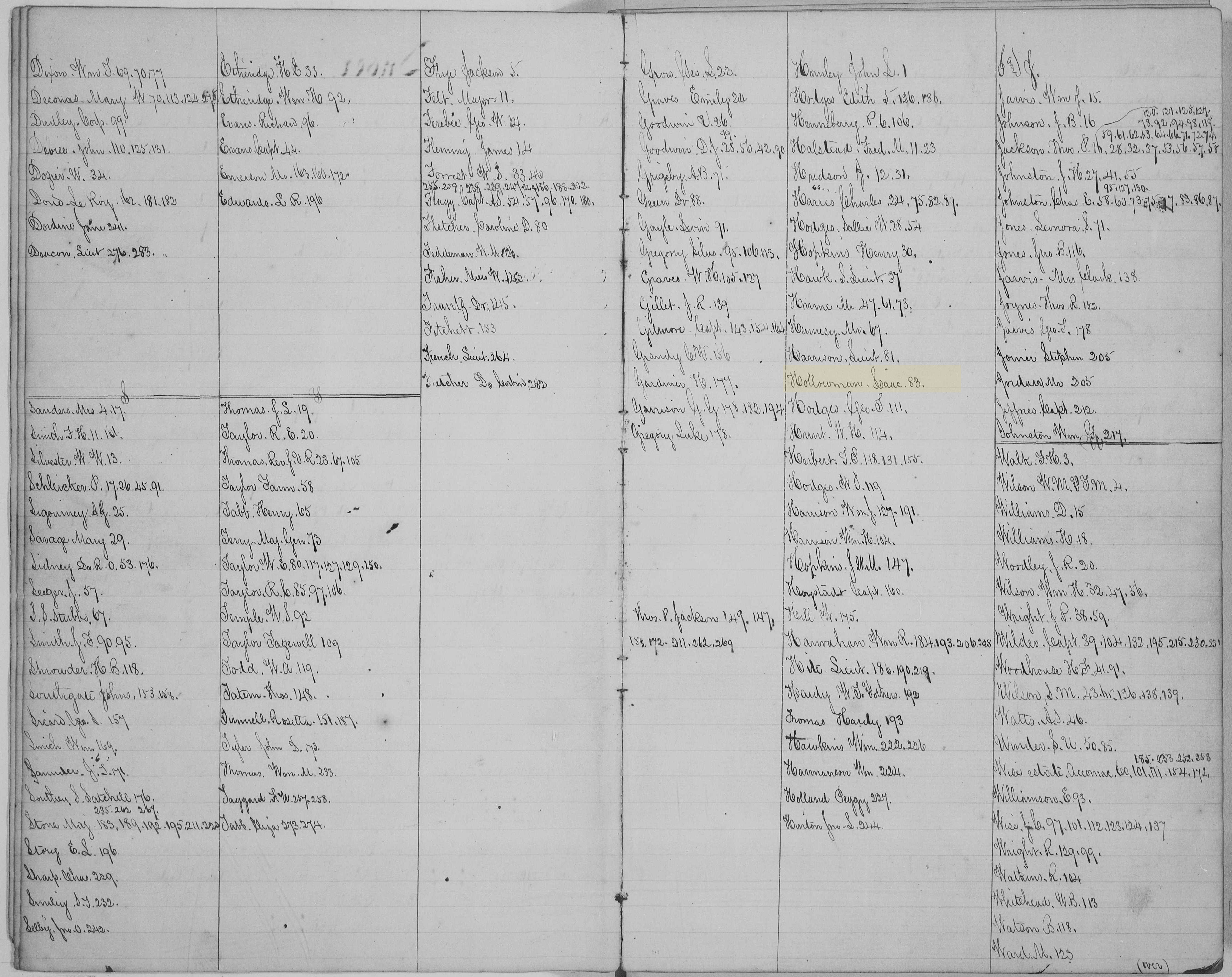
This page (which is marked as page 83, matching the index) contains a November 3, 1865, entry where Capt. Stuart Barnes returns the statement of money due Isaac Hollowman to Capt. Flagg. Barnes notes that the case is “not under my jurisdiction” and asks Flagg to have the money collected and sent through the office.
I don’t have a record of the request being resolved after the request was forwarded to several offices and returned.
Facilitating Transportation to Former Homes
A primary function of the Fort Monroe office was organizing the relocation of free dpeople who wished to return to their “former homes.” The office compiled detailed lists of families requesting transportation. The stated administrative goal for these relocations was “to relieve the Government of their support and to prevent destitution”.
In a previous post, I showed this request for transportation from Fortress Monroe for Isaac Holleman and his family an entire year after the previous request for wages.
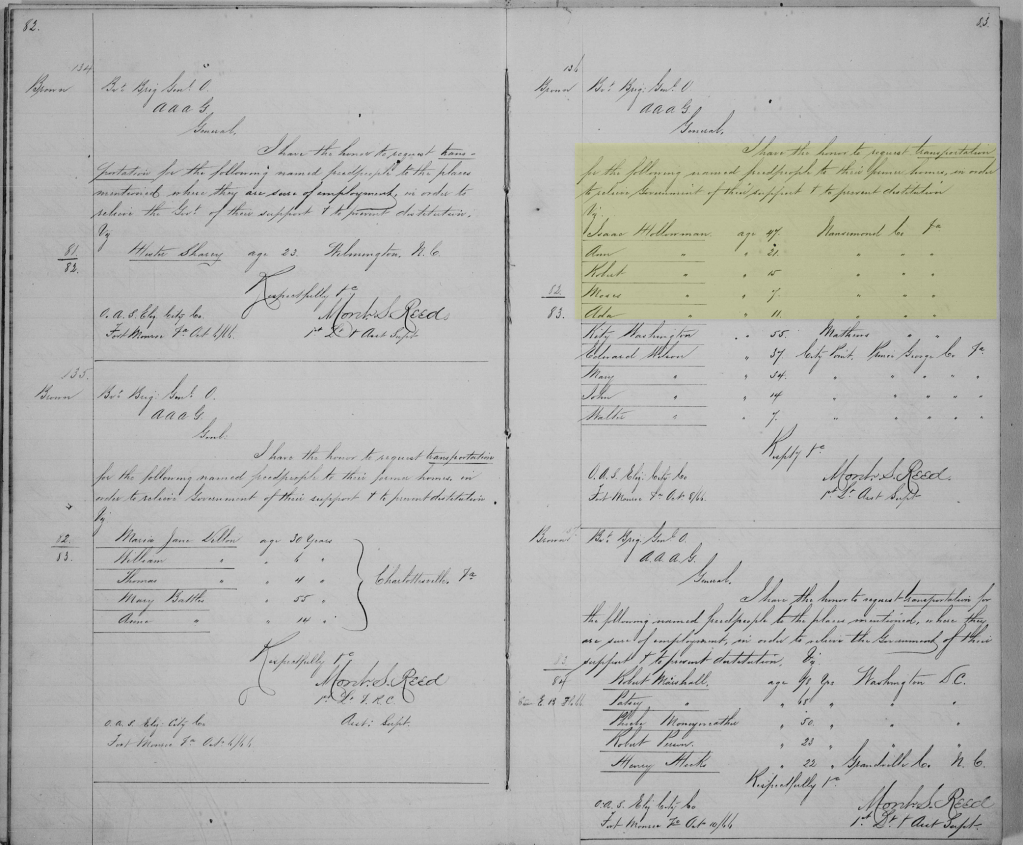
This record from October 1866 shows 1st Lt. Mont. S. Reed submitting a formal request for Isaac Holloman to travel to Nansemond County, accompanied by his wife, Ann, and children, Robert, Moses, and Ada).
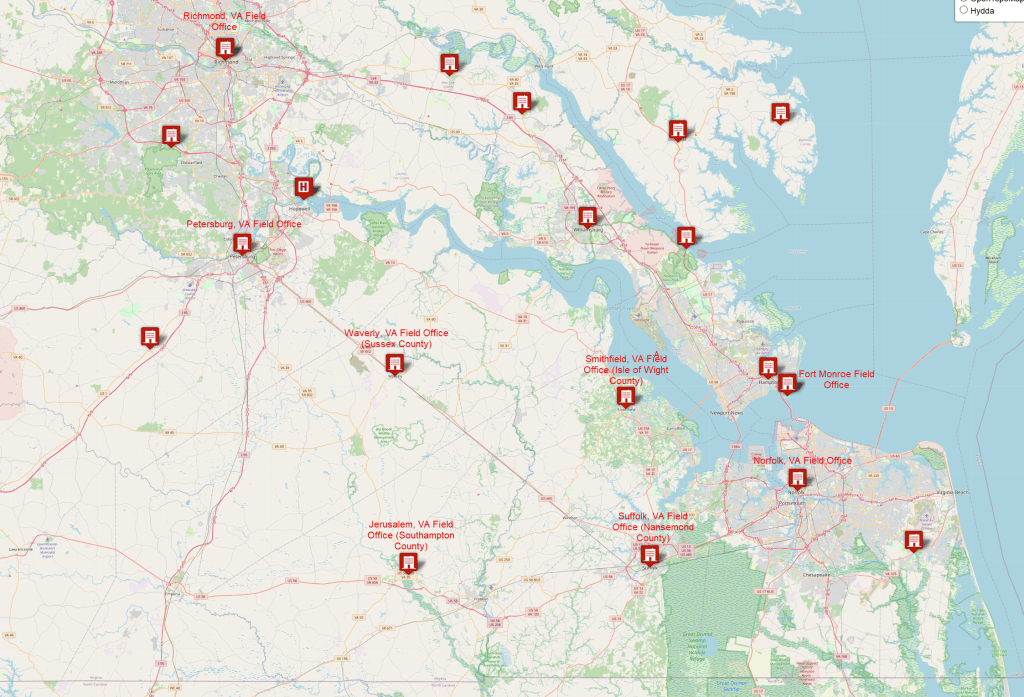
Below is a map of the Freedsmen’s Bureau offices located in southeastern Virginia from Mapping the Freedmen’s Bureau.
Sources:
- “The Freedmen’s Bureau”, The U.S. National Archives and Records Administration, https://www.archives.gov/research/african-americans/freedmens-bureau
- “Virginia, Freedmen’s Bureau Field Office Records, 1865-1967,” database with images, FamilySearch (https://familysearch.org/ark:/61903/3:1:S3HT-698S-QTR?cc=1596147&wc=9LMK-L23%3A1078520902%2C1078524301 : 25 June 2014), Petersburg (subassistant commissioner) > Roll 150, Endorsements sent and received, vol 1, Jul 1865-Dec 1868 > image 91 of 328; citing NARA microfilm publication M1913 (College Park, Maryland: National Archives and Records Administration, n.d.).
- “Virginia, Freedmen’s Bureau Field Office Records, 1865-1967,” database with images, FamilySearch (https://familysearch.org/ark:/61903/3:1:S3HY-6793-F8F?cc=1596147&wc=9LMP-GP8%3A1078519902%2C1078519703 : 25 June 2014), Norfolk (subassistant commissioner, 1st district) > Roll 137, Registers of letters received and endorsements sent, vol 1-8, Jun 1865-Jan 1869 > image 119 of 919; citing NARA microfilm publication M1913 (College Park, Maryland: National Archives and Records Administration, n.d.).
- “Virginia, Freedmen’s Bureau Field Office Records, 1865-1967,” database with images, FamilySearch (https://familysearch.org/ark:/61903/3:1:S3HY-6793-F1T?cc=1596147&wc=9LMP-GP8%3A1078519902%2C1078519703 : 25 June 2014), Norfolk (subassistant commissioner, 1st district) > Roll 137, Registers of letters received and endorsements sent, vol 1-8, Jun 1865-Jan 1869 > image 140 of 919; citing NARA microfilm publication M1913 (College Park, Maryland: National Archives and Records Administration, n.d.).
- “Virginia, Freedmen’s Bureau Field Office Records, 1865-1967,” database with images, FamilySearch (https://familysearch.org/ark:/61903/3:1:S3HY-6793-LTC?cc=1596147&wc=9LMP-GP8%3A1078519902%2C1078519703 : 25 June 2014), Norfolk (subassistant commissioner, 1st district) > Roll 137, Registers of letters received and endorsements sent, vol 1-8, Jun 1865-Jan 1869 > image 162 of 919; citing NARA microfilm publication M1913 (College Park, Maryland: National Archives and Records Administration, n.d.).
- “Virginia, Freedmen’s Bureau Field Office Records, 1865-1967,” database with images, FamilySearch (https://familysearch.org/ark:/61903/3:1:S3HY-6793-KL5?cc=1596147&wc=9LMP-GP8%3A1078519902%2C1078519703 : 25 June 2014), Norfolk (subassistant commissioner, 1st district) > Roll 137, Registers of letters received and endorsements sent, vol 1-8, Jun 1865-Jan 1869 > image 168 of 919; citing NARA microfilm publication M1913 (College Park, Maryland: National Archives and Records Administration, n.d.).
- “Virginia, Freedmen’s Bureau Field Office Records, 1865-1872,” database with images, FamilySearch (https://familysearch.org/ark:/61903/3:1:S3HT-XCSQ-FKJ?cc=1596147&wc=9LMLN36% 3A1078519202%2C1078520304 : 25 June 2014), Fort Monroe (assistant subassistant commissioner) > Roll 128, Letters sent, vol 1-2, Mar 1866-May 1868 > image 68 of 158; citing NARA microfilm publication M1913 (College Park, Maryland: National Archives and Records Administration, n.d.).
 genealo.ME