I had previously posted most of this material separately, but I wanted to bring it together to show the full picture.
Back when I first wanted to know the family history, I was told that we were descendants of Solomon Butler, a free Black man, and a “slave girl.” The story preserved Solomon’s name, but not Charlotte’s. Why had her identity disappeared from the family account? While researching the brothers, Anthony and Moses Allmond, from whom I was told that all the Black Allmonds in Isle of Wight descend, I found their mother, Charlotte, on the 1870 Census. I also confirmed her name on Anthony’s death certificate. Both records, however, were created after slavery had ended.
Because Solomon was free, he was easy to find as his name appeared clearly in the 1850 census. Charlotte remained a ghost in the records for decades. She was “invisible” in the standard inhabitant schedules, existing only as a nameless statistic in slave schedules until she finally emerged as a head of household in 1870. Solving the mystery of why they appeared so differently in the paper trail revealed the story of a family living together while being kept legally worlds apart.
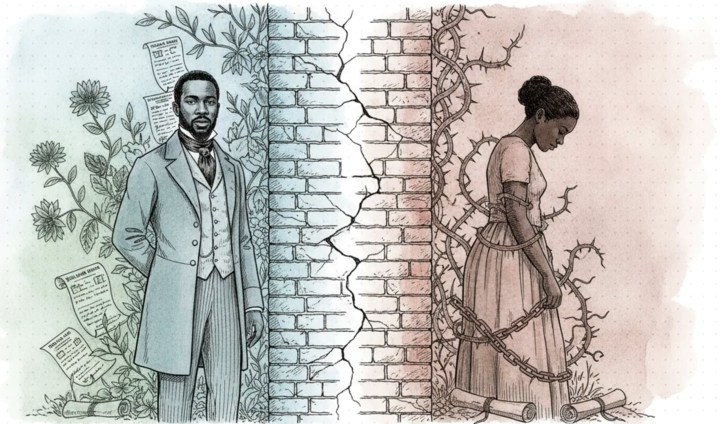
The 1850 Snapshot: Parallel Lives on the Allmond Property
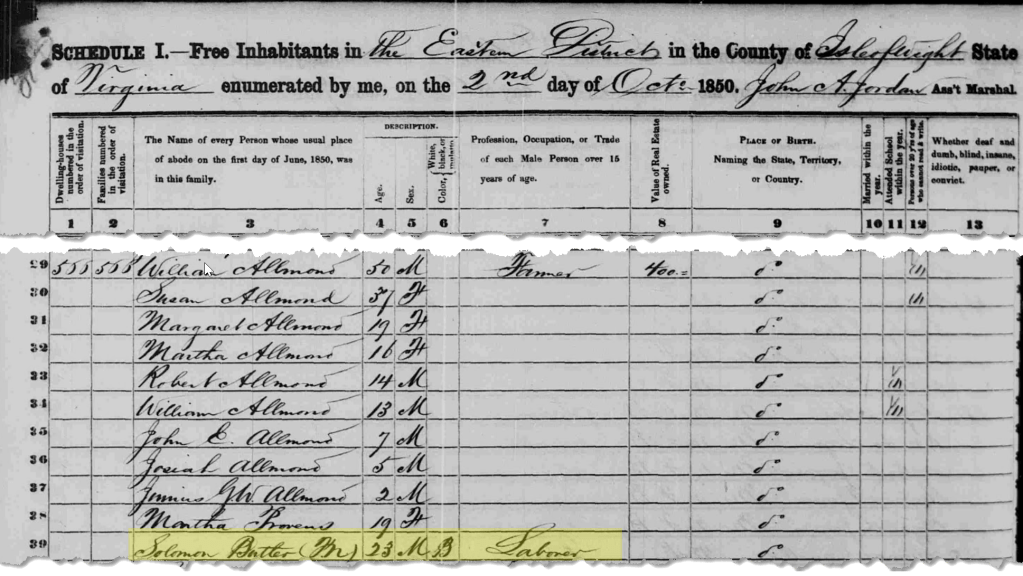
In 1850, the census taker visited the property of William Allmond in Isle of Wight and recorded two parallel realities. On “Schedule 1” for Free Inhabitants, Solomon Butler appeared as a 23-year-old free Black man working as a laborer. What made this record so astonishing to me was that Solomon wasn’t merely living nearby; he was living in a household filled with members of the Allmond family. As a free man of color, the law required his name and age to be documented, giving him a historical presence that Charlotte was denied.
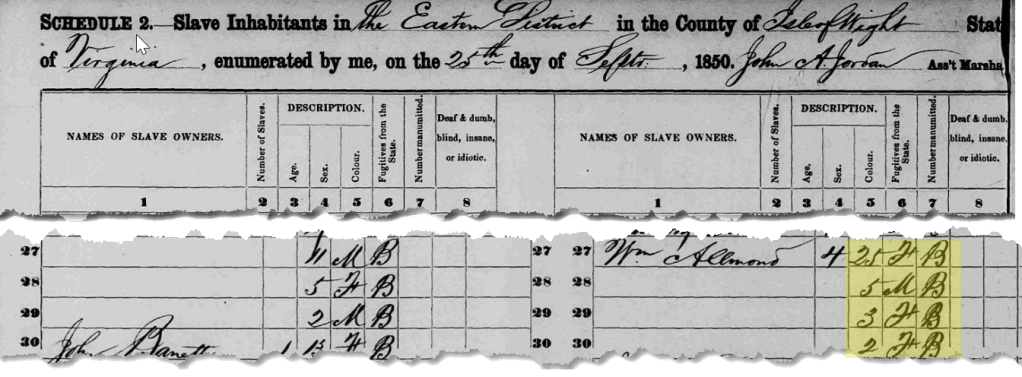
To find Charlotte in 1850, one had to turn to “Schedule 2,” the Slave Schedule. There, she was not recorded as a person with a name, but a tally mark under the ownership of William Allmond. She was listed simply as a “Negro woman,” aged 25. Taken together, the two schedules strongly suggested that Solomon and Charlotte were living on the same property, although Charlotte was not identified by name in the slave schedule.
Paper Trails: The Will of William Allmond
Charlotte’s name finally surfaced in 1854, but only through the lens of her status as property. After William Allmond died, his will provided a rare glimpse into the family Charlotte was raising. In the probate records, her name finally appeared, but it was listed alongside household goods like kitchen utensils and feather beds.
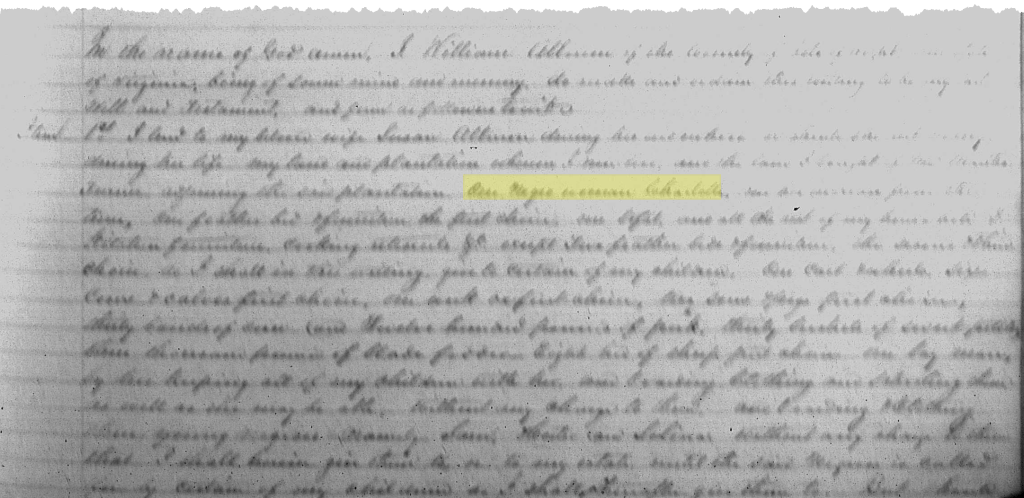



The will named the following individuals to be distributed among the heirs:
- “one Negro woman Charlotte”
- “one Negro boy Sam”
- “one Negro girl Hester”
- “one Negro girl Salina”
Anthony did not appear in the will even though he was about a year old. I believed that Salina, named in the 1854 record, was the daughter recorded as Liney in 1870 and as Malinda in 1880. Her approximate age remained consistent across those records. This document, although cold in its legal purpose, provided the vital link connecting Charlotte to her children.
The Next Generation: Anthony and Moses
Beyond the will, the Virginia birth registers and slave birth indexes allowed me to determine the birth dates of Charlotte’s youngest sons. These records confirmed they were born on the Allmond farm:
- Anthony (Tony): Born May 15, 1853, to Charlotte. William Allmond was identified in the register’s “Owner” field.
- Moses: Born November 11, 1856, to Charlotte. Susan Allmond was listed as the “owner”, as William had died by the time Moses was born.

The Virginia Slave Birth Index was compiled from individual county birth registers. When a child was born free, the register generally identified the father; when a child was born enslaved, it identified the enslaver instead. Consequently, the birth entries for Anthony and Moses named Charlotte as their mother and the Allmond who enslaved them, but not their father.
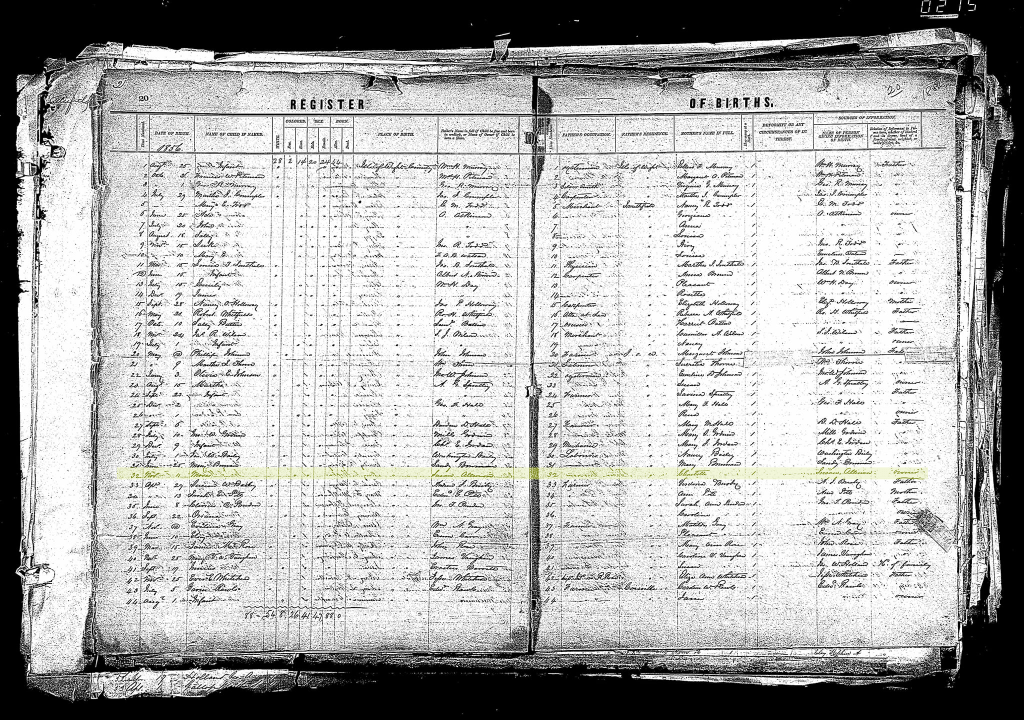
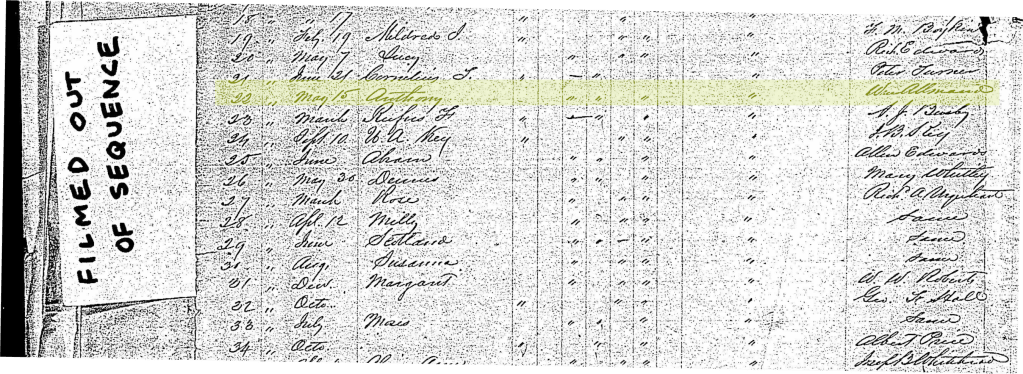
Regardless of their fathers’ legal status, Charlotte’s children were born enslaved due to partus sequitur ventrem, a law passed by the Virginia General Assembly in December 1662, which stated, “Negro womens children to serve according to the condition of the mother.” Solomon’s own free status was likely the result of his mother being a white woman according to the oral history.
1860: Separate Households and Legal Worlds
By 1860, the physical and legal paths of this family diverged sharply. A close examination of the 1860 records revealed one of the census’s common quirks: Solomon Butler, who was 23 in 1850, was listed as only 27 in 1860. Despite the age discrepancy, the surrounding evidence strongly suggested that he was the same person. He was living in the household of Washington Bailey, surrounded by other free Blacks including Mary, Ann H., and Wm B. Bailey.
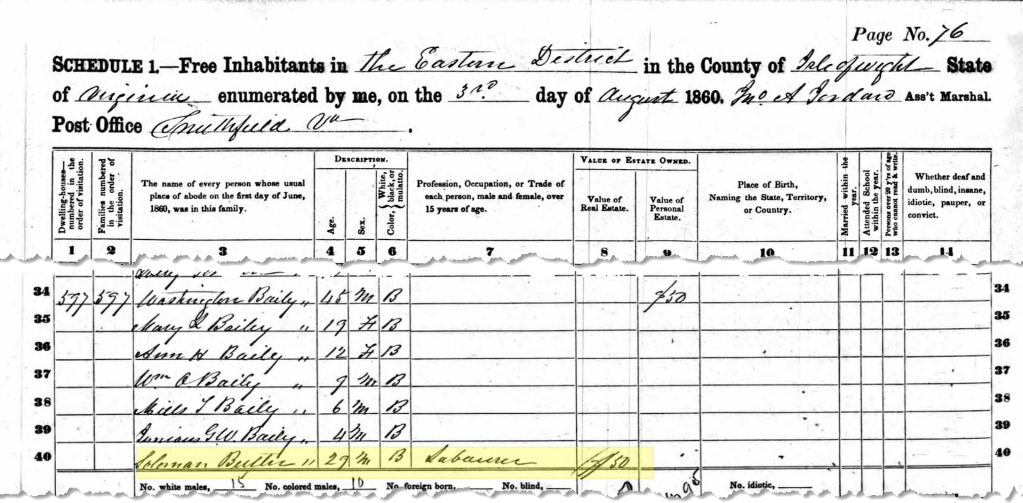
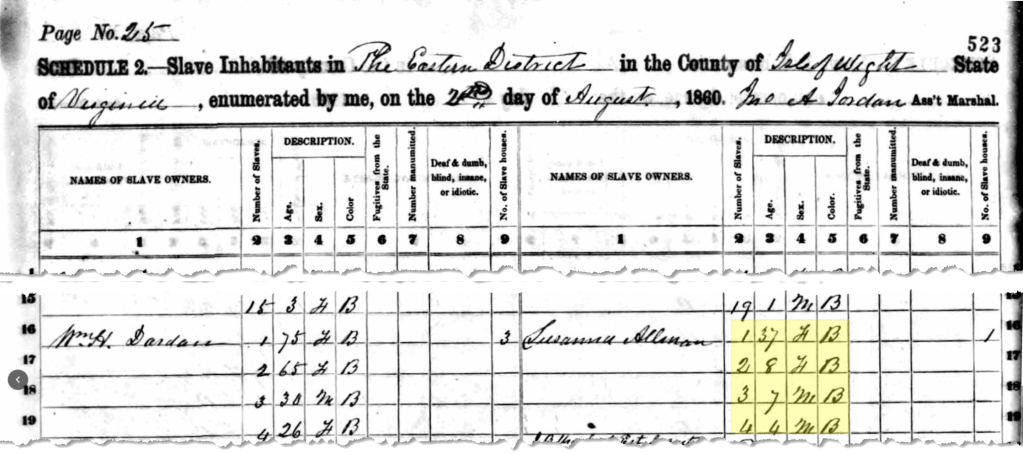
While Solomon lived in this free community, Charlotte and her children remained enslaved and largely obscured from the named census record. The 1860 Slave Schedule showed that a Black woman and three children (presumably Charlotte and her children) were still under the control of Susanna (Susan) Allmond, the widow of William Allmond. Note that corresponding ages for the older children (Sam and Hester) did not appear on the schedule.
Post-War Reality: 1870 and the New Households
The 1870 census marked a profound change in Charlotte’s documentary life: for the first time, she appeared by name as the head of her own household. She was recorded using the surname Allman, a variation of her former enslaver’s name. In 1870, Charlotte was living with her children: Anthony, Liney, Moses, and Sam. She was living two households away from her former enslaver, Susan Allmond (1).
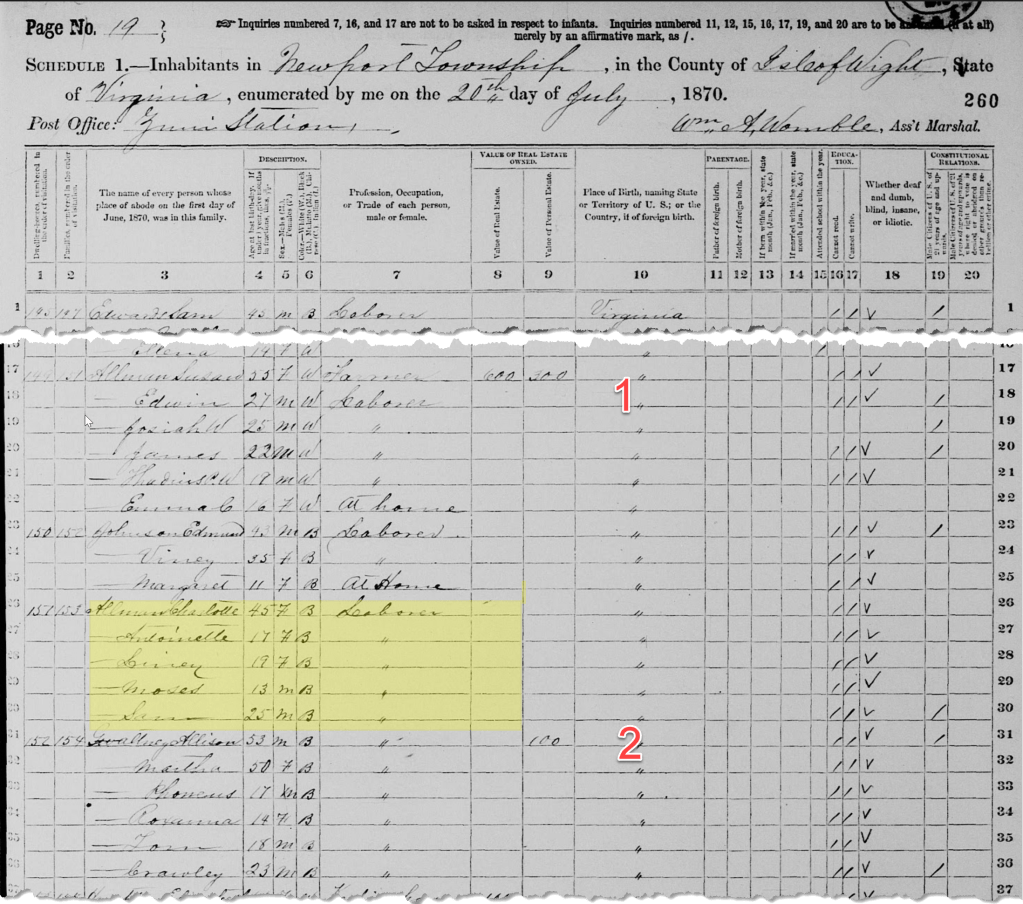
However, freedom did not bring a family reunion. The records showed that Solomon and Charlotte had already begun the process of building separate lives:
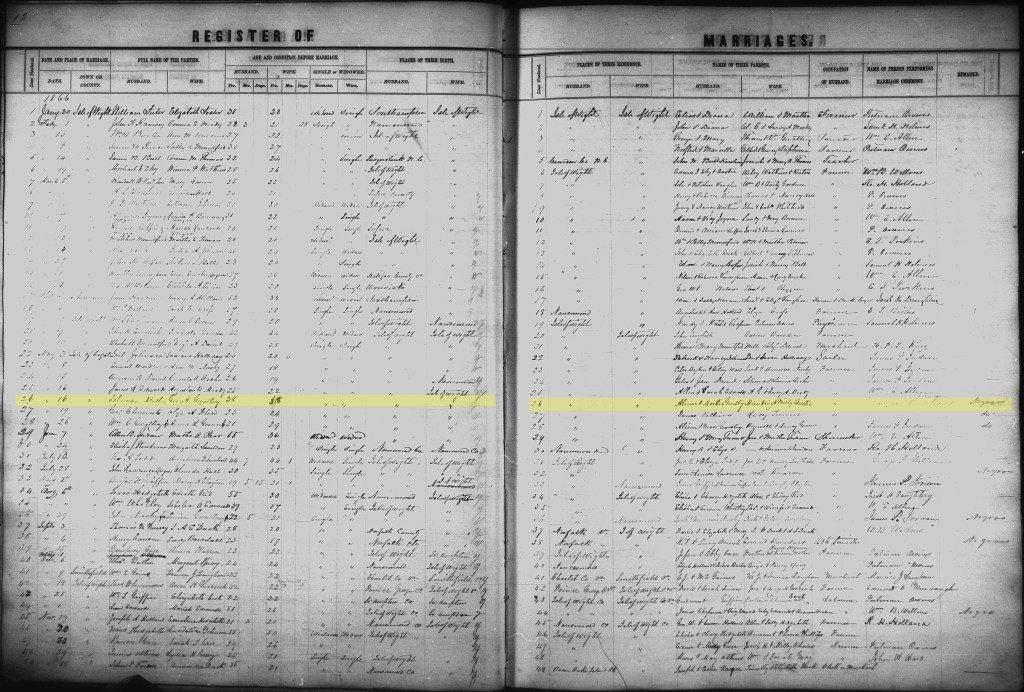
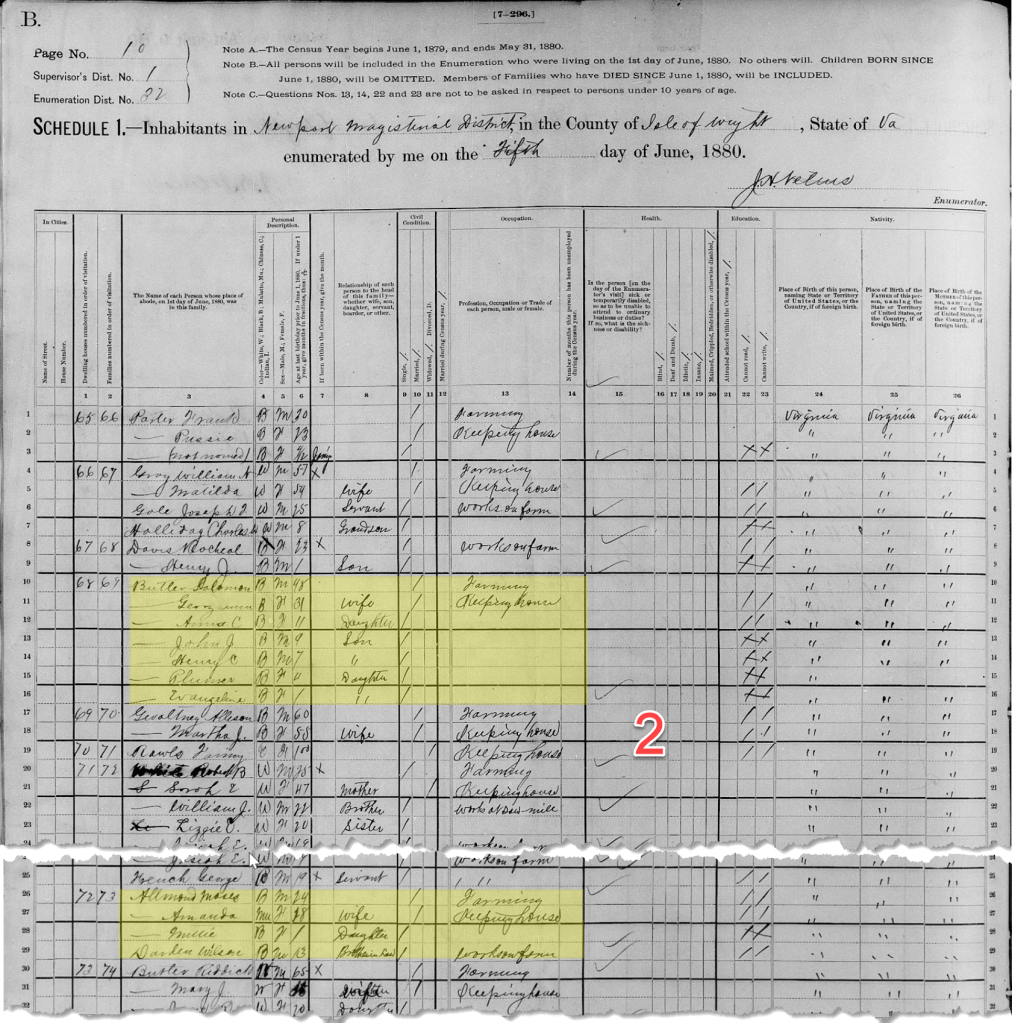
- Solomon Butler married Georgianna Gwaltney on January 20, 1866. I have not found Solomon on the 1870 Census, but the very next listing after Charlotte’s household was the household of Solomon’s in-laws, Allison and Martha Gwaltney (2). The marriage register recorded Solomon’s parents as Moses King and Milly Butler.
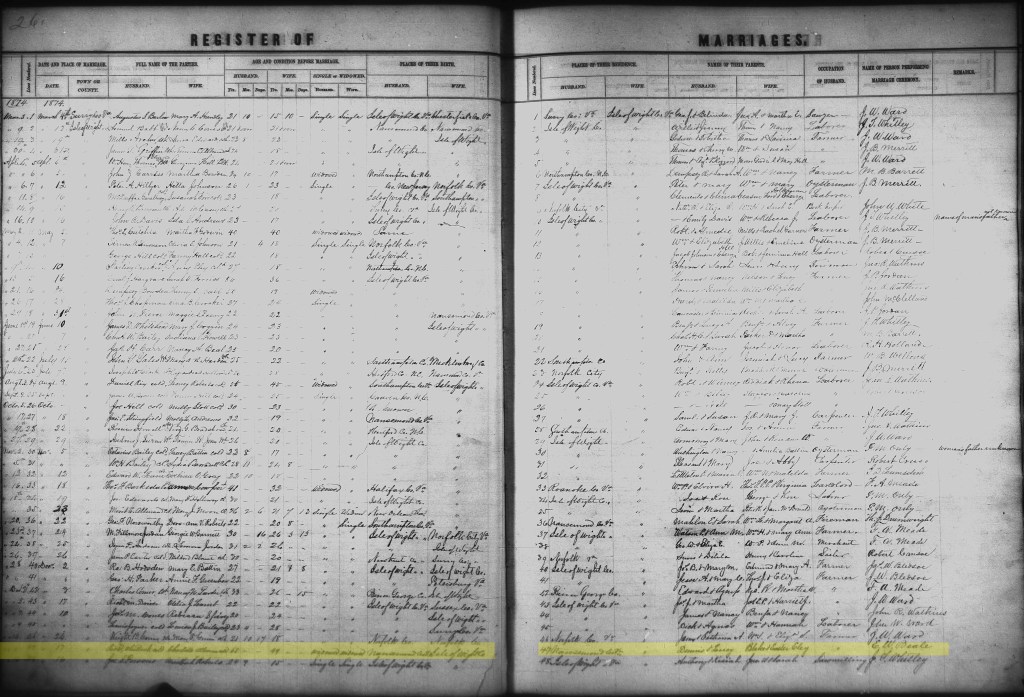
- Charlotte Allman married Richard Whitlock on March 5, 1874. The marriage register recorded Charlotte’s parents as Blake and Easter Eley.
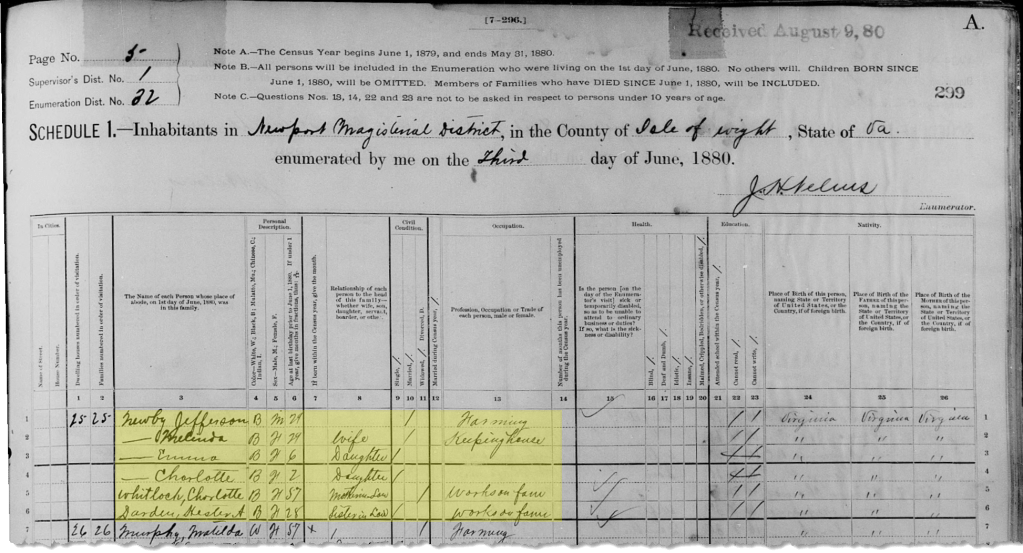
By 1880, the records documented two separate households. The family Solomon and Charlotte had formed was no longer recorded as a single domestic unit. Solomon was found with Georgianna and their children, while Charlotte (as Charlotte Whitlock) was living with her daughter Malinda, Malinda’s husband, Jefferson Newby, and children along with her other daughter Hester.

Conclusion
It was gratifying to see Charlotte finally emerge by name in the surviving public record. The family Solomon and Charlotte had formed, despite the legal barriers that kept them from being recognized as a household, was fractured by slavery and its aftermath. They survived slavery, but the postwar records found them building two different households.
Additional Notes
Regarding the parentage of the other three children:
- Anthony’s death certificate listed Solomon Butler and Charlotte Eley as his parents. Note that Charlotte’s parents were recorded on the marriage register as Blake and Easter Eley.
- Malinda Allmond Newby’s death certificate listed Solomon Butler and Charlotte Allmond as her parents.
- Hester Darden Happer’s death certificate listed Richard Darden and Charlotte Allmond as her parents.
- I have no documents that explicitly list Moses’ father.
- Sam is proving difficult to track at this time.
Sources
United States Federal Census Records
United States. Bureau of the Census. Seventh Census of the United States, 1850. Washington, D.C.: National Archives and Records Administration (NARA). Series Number: M432; Residence Date: 1850; Home in 1850: Eastern District, Isle of Wight, Virginia; Roll: 952; Page: 154b
- Isle of Wight County, Virginia, population schedule, Eastern District, page 160B, household 697.
- Isle of Wight County, Virginia, slave schedule, Eastern District, page unnumbered, slave owner William Allmond.
United States. Bureau of the Census. Eighth Census of the United States, 1860. Washington, D.C.: National Archives and Records Administration (NARA). Record Group Number: 29; Series Number: M653; Residence Date: 1860; Home in 1860: Eastern District, Isle of Wight, Virginia; Roll: M653_1354; Page: 356
- Isle of Wight County, Virginia, population schedule, Eastern District, page 88, household of Susan Allmond.
- Isle of Wight County, Virginia, population schedule, Western District (Newport post office), page 150, household 238, household of Washington Bailey.
- Isle of Wight County, Virginia, slave schedule, Eastern District, page 13, slave owner Susanna Allmond.
United States. Bureau of the Census. Ninth Census of the United States, 1870. Washington, D.C.: National Archives and Records Administration (NARA). Census Place: Newport, Isle of Wight, Virginia; Roll: M593_1657; Page: 260A
- Isle of Wight County, Virginia, population schedule, Newport Township (Newport post office), page 125, household 202, household of Charlotte Allman.
United States. Bureau of the Census. Tenth Census of the United States, 1880. Washington, D.C.: National Archives and Records Administration (NARA). NARA microfilm publication T9, 1,454 rolls. Records of the Bureau of the Census, Record Group 29.
- Isle of Wight County, Virginia, population schedule, Newport Magisterial District, enumeration district (ED) 31, page 12, household 112, household of Solomon Butler.
- Isle of Wight County, Virginia, population schedule, Newport Magisterial District, enumeration district (ED) 31, page 48A, household 430, household of Charlotte Whitlock.
Virginia State & County Records (Isle of Wight)
Virginia State Library and Archives. “Virginia Slave Birth Index, 1853–1865.” Alphabetical index cards. Richmond, Virginia.
- County index entries for Toney Allmond (1853) and Moses Allmond (1856), Isle of Wight County.
Virginia. Isle of Wight County. “Register of Births, 1853–1896.” County Clerk’s Office, Isle of Wight.
- Birth entry for Tony Allmond, born 15 May 1853 to Charlotte, owner William Allmond.
- Birth entry for Moses Allmond, born 11 November 1856 to Charlotte, owner Susan Allmon.
Virginia. Isle of Wight County. “Marriage Registers, 1854–1906.” County Clerk’s Office, Isle of Wight.
- Solomon Butler and Georgianna Gwaltney, 22 November 1866.
- Richard Whitlock and Charlotte Allmond, 20 August 1874.
Virginia. Isle of Wight County. “Will Books.” County Clerk’s Office, Isle of Wight.
- Last Will and Testament of William Allmond. Dated 1845; probated 6 March 1854.
Virginia Department of Health; Richmond, Virginia; Virginia Deaths, 1912-2014.
- Hester Harper (Darden), 22 March 1917.
- Anthony Allmond, 10 October 1917.
- Malinda Newby (Allmond), 30 January 1928.
Encyclopedia Virginia
- General Assembly. “Negro womens children to serve according to the condition of the mother” (1662). (December 7, 2020). In Encyclopedia Virginia. https://encyclopediavirginia.org/primary-documents/negro-womens-children-to-serve-according-to-the-condition-of-the-mother-1662.

